

The Interface Problem No One Is Talking About
Over the past two years, enterprises have made meaningful progress in adopting generative AI. Chat interfaces have become the default access point. You will find them embedded in internal tools, customer experiences, and productivity platforms.
And yet, despite this adoption, something hasn’t changed: how work actually gets done.
- Executives still make decisions in meetings.
- Operators still respond in real time to incidents.
- Customer interactions still happen through voice.
The result is a growing disconnect between how humans operate and how AI systems are accessed. Chat requires a break in flow. The typical flow is to type, wait, read, interpret—while real enterprise work demands continuous, real-time interaction.
This is the gap voice closes.
Chat Was the Bridge. It Is Not the Destination.
Chat interfaces were a necessary step. They made AI accessible without requiring deep system integration. But they also introduced friction into environments where speed and clarity matter most.
Typing forces translation, turning natural thought into structured prompts. It introduces unneeded latency into decision cycles. And it performs poorly in environments where attention is already divided: like most zoom/teams calls I attend.
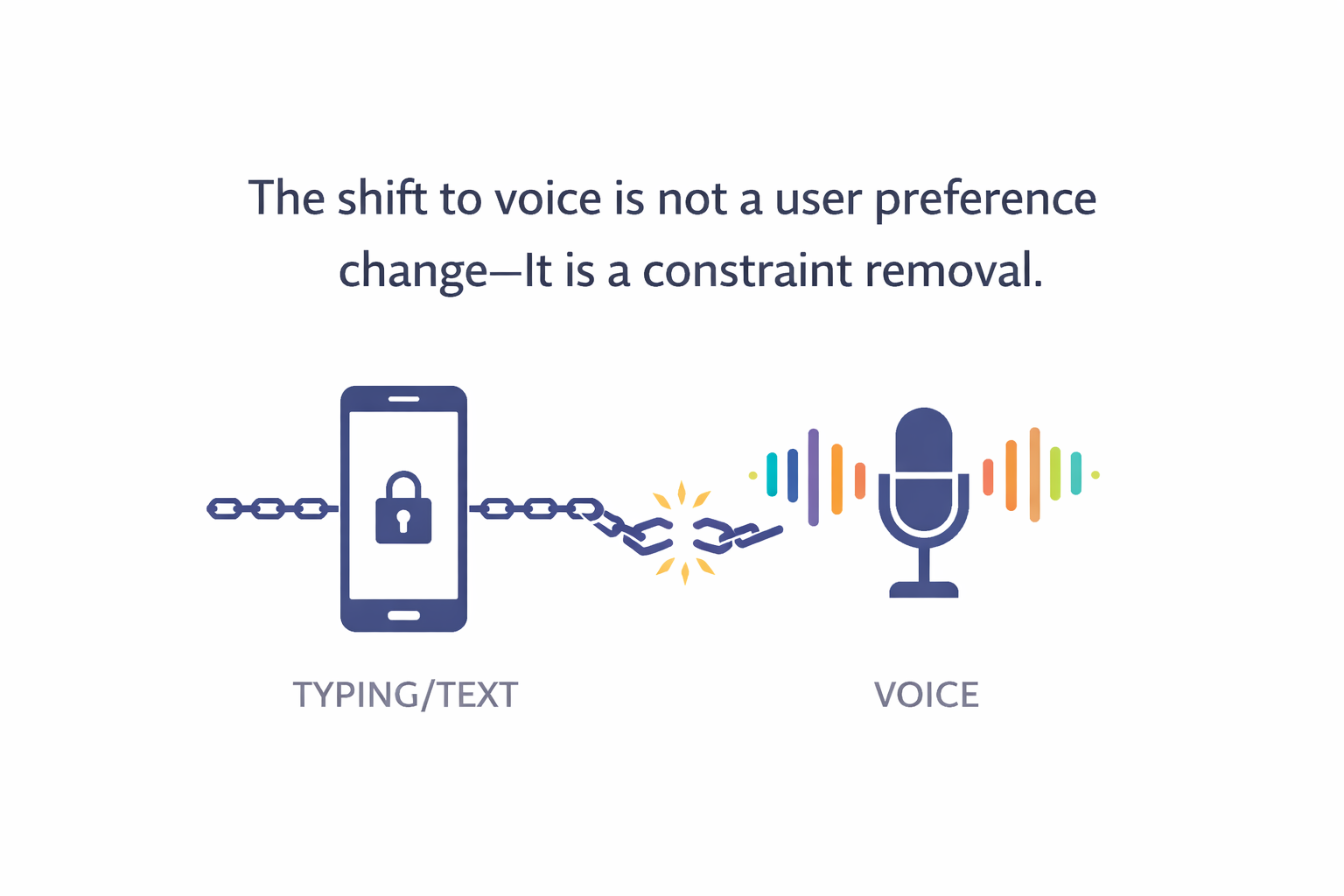
Voice eliminates that translation layer. It aligns directly with how humans already communicate. It reduces cognitive overhead. And most importantly, it allows AI to exist inside the flow of work, not outside of it.
Why Voice, Why Now
This shift is not theoretical. It is the result of several technical advancements converging at once.
Real-time speech-to-speech models have reached latency thresholds that support live interaction.
- Streaming architectures have replaced traditional request/response patterns, enabling continuous input and output.
- Cloud-native GPU infrastructure has made high-performance inference deployable within enterprise boundaries.
- At the same time, model optimization has closed the gap between research and production.
What was experimental two years ago is now operationally viable.
The Throughput Advantage: Voice Operates at Human Speed
One of the clearest indicators of where this is heading comes from a simple but powerful comparison: how fast humans can communicate.
Human Communication Speed Comparison
WPM (Words Per Minute)
200 ┤
    │                         ██████████████████████
    │                         █   FAST SPEECH (180–200)
175 ┤                 ████████████████████
    │                 █   PRESENTATION / FAST (150–180)
150 ┤        █████████████████████
    │        █   CONVERSATIONAL SPEECH (~150)
125 ┤
    │
100 ┤
    │
 75 ┤            ███████████████
    │            █   PROFESSIONAL TYPING (60–80)
 50 ┤      ███████████
    │      █   AVERAGE TYPING (~40)
 25 ┤
    │
  0 └──────────────────────────────────────────────
        Typing                     Speaking
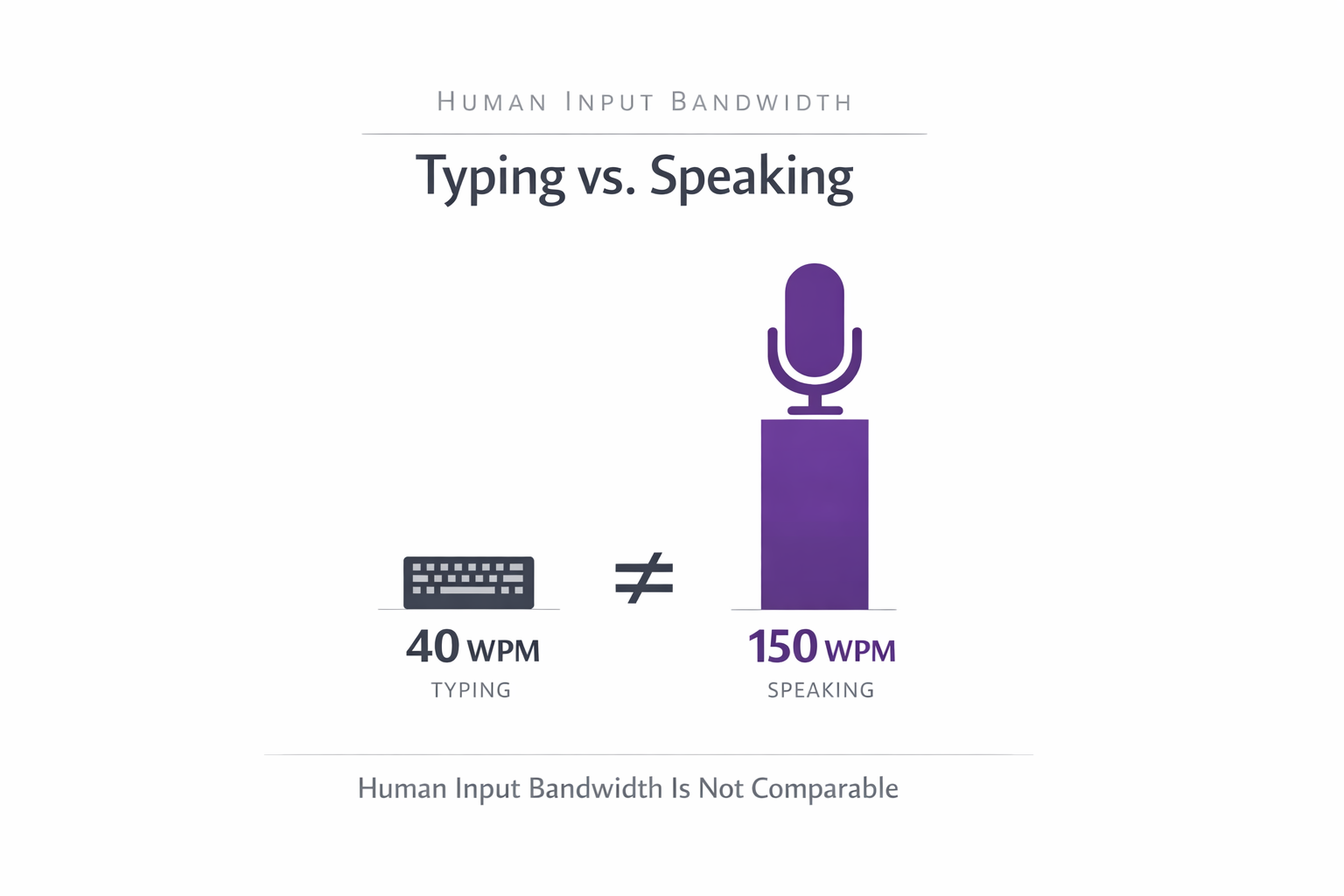
Typing (average knowledge worker): ~40 words per minute
Speaking (natural conversation): ~150 words per minute
Relative Input Throughput: ~3.5–4x faster via voice
This is not a marginal gain. It is a step-function improvement in how quickly information can be exchanged.
But the real advantage is not just speed, it is continuity. Speaking allows individuals to maintain context, emotion, and flow without interruption. Typing fragments that process.
If AI is meant to accelerate decision-making, it must operate at the speed and continuity of human conversation, not at the pace of a keyboard.
From Tool to Participant
The most important shift voice enables is not efficiency. It is role transformation.
Chat-based AI behaves like a tool. The typical flow is that you stop, ask a question, receive a response, and resume your work.
Voice-based AI behaves more like a participant. It can listen continuously, respond in real time, and contribute within dynamic environments. It does not require a pause in workflow. It operates alongside it.
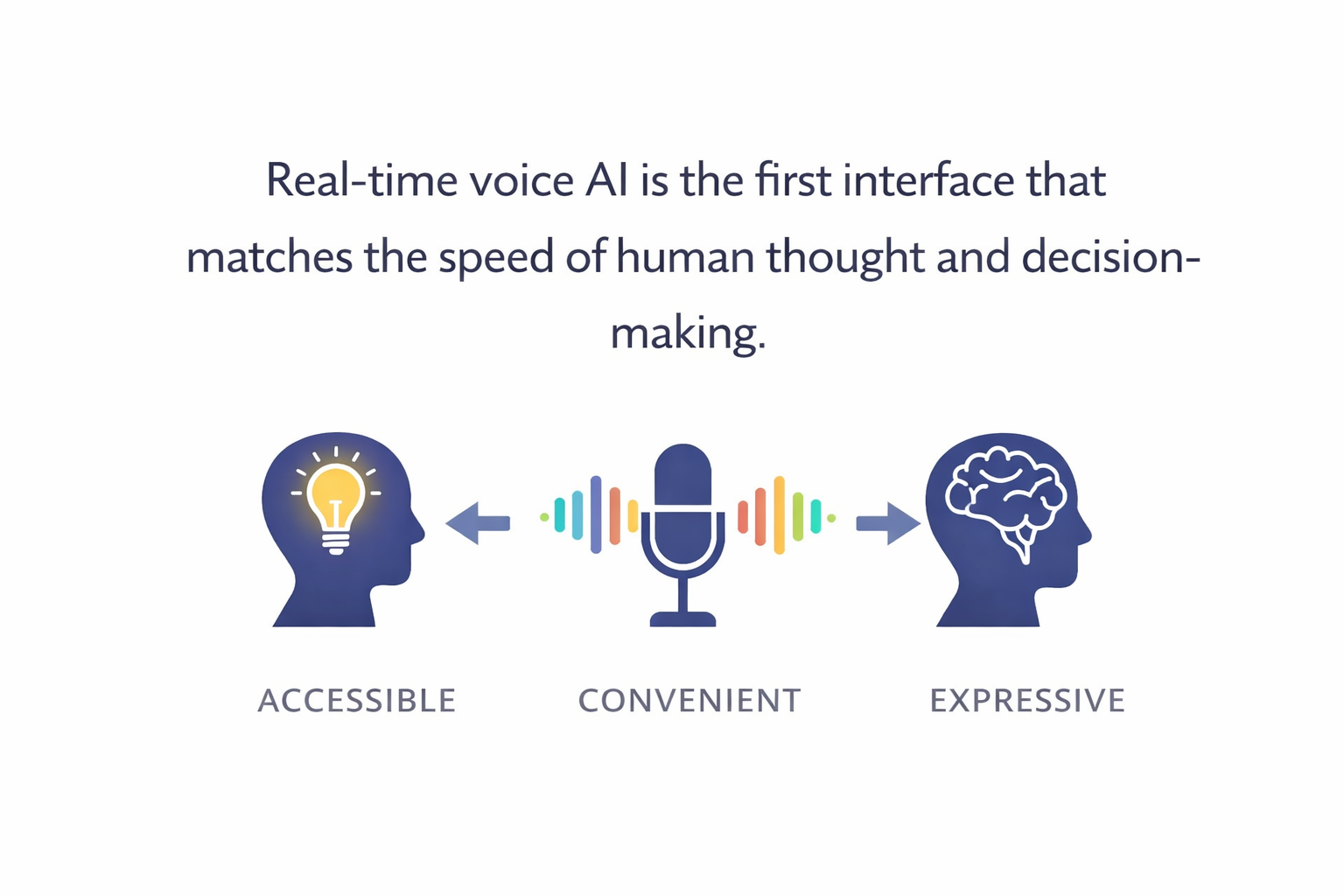
This distinction matters. In high-value enterprise contexts, the cost of interruption is often greater than the cost of delay. Voice removes both.
From Concept to Deployment
There is still a perception in many organizations that real-time voice AI is experimental. That perception is outdated.
Platforms that BSC has deployed, like PersonaPlex, demonstrate what this looks like when built as a production system rather than a prototype. Real-time speech-to-speech pipelines, custom voice personas, models that speak and listen simultaneously, and cloud-native deployment models can now be integrated into a cohesive architecture that meets enterprise requirements for security, latency, and control.
The significance is not that these capabilities exist. It is that they can be deployed today inside enterprise environments, not just demonstrated in controlled settings.
What This Means for Enterprise Leaders
This transition will not be uniform. Some organizations will continue to invest in chat-based interfaces because they are familiar and easier to deploy. Others will begin to integrate voice into high-value workflows where speed, clarity, and continuity are critical.
The difference between those two groups will become increasingly visible.
Organizations that move early will begin to compress decision cycles, reduce friction in operational workflows, and create more natural and differentiated customer and employee experiences. Those that delay will find themselves with AI capabilities that exist, but are not fully utilized where work actually happens.
The strategic question is no longer whether AI can be integrated into the enterprise. It is whether it can be integrated into the way people actually operate.
The Next Interface Shift Is Already Underway
Every major technology evolution has included a shift in interface.
- Command lines gave way to graphical interfaces.
- Desktops gave way to mobile.
- Search gave way to conversational AI.
The next transition is already emerging - from chat to voice.
This shift will not be driven by preference or novelty. It will be driven by performance; by the simple reality that voice enables faster, more natural, and more continuous interaction.
Closing Perspective
Voice is not an enhancement to AI interfaces. It is the first interface that allows AI to operate at the speed, modality, and context of human interaction.
The organizations that recognize this early will not just improve efficiency. They will fundamentally change how decisions are made, how work flows, and how value is created.
The rest will still be typing.