Using Amazon ElastiCache for Redis as a Session Cache-Store - Part 2
This is the second and final part of our series on Using Amazon ElastiCache for Redis as a Session Cache-Store. The first article discussed what technol...

Dallin Rasmuson
2024-06-25
This is the second and final part of our series on Using Amazon ElastiCache for Redis as a Session Cache-Store. The first article discussed what technologies we will use, the prerequisites and architecture overview, and the configuration and setup process.
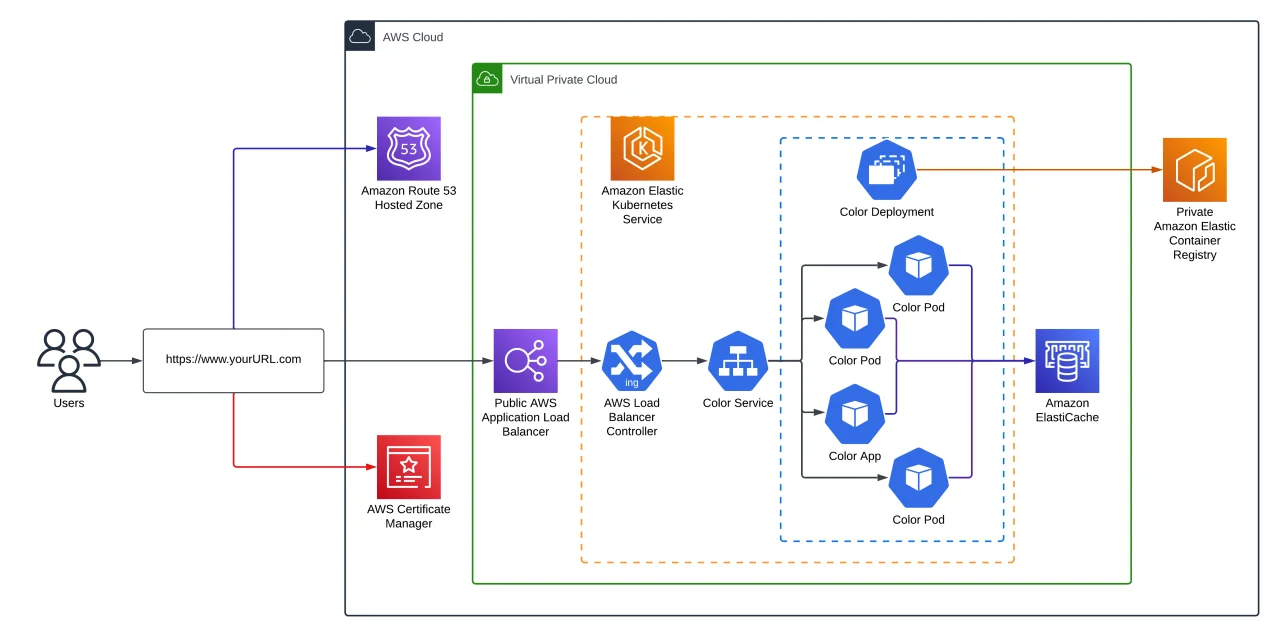
In this part two and final article, we will be working on these tasks.
- Configure access to Amazon EKS Cluster
- Build and deploy our Docker image to Amazon ECR
- Deploy supporting services to Kubernetes
- Deploy Python Flask Color application to Kubernetes
- Demonstrate how Session Cache works with our Python Flask Color application and Amazon ElastiCache
- Clean up apps and infrastructure
You can access all of the code used in my GitHub Repository.
All the commands are run from the root directory of the GitHub repo.
Configure access to Amazon EKS Cluster
Amazon EKS Cluster details can be extracted from terraform output or from the AWS Console to get the name of the cluster. This following command can be used to update the kubeconfig in your local machine where you run kubectl commands to interact with your EKS Cluster.
AWS_REGION=$(terraform output -raw aws_region)
EKS_CLUSTER_NAME=$(terraform output -raw eks_cluster_name)
aws eks --region $AWS_REGION update-kubeconfig --name $EKS_CLUSTER_NAME
Results of configuring kubeconfig.
Build the Docker image
Set the variables needed to build and push your Docker image. Navigate to the root of the directory of the GitHub repo and run the following commands:
AWS_REGION=$(terraform output -raw aws_region)
ECR_REPO=$(terraform output -raw ecr_repo_url)
To build the Docker image, run the following command:
docker build --platform linux/amd64 --no-cache --pull -t ${ECR_REPO}:latest ./color
Push the Docker image to Amazon ECR
To push the Docker image to Amazon ECR, authenticate to your private Amazon ECR registry. To do this, run the following command:
aws ecr get-login-password --region $AWS_REGION
Dallin Rasmuson
Solutions Architect
Read More
View all posts
AI/ML
Why Enterprise AI Must Be Application-Led, Not Agent-Led
A deep dive by Todd Bernson, CTO and Chief AI Officer, on why enterprise AI systems should be architected as application-led, deterministic platforms with embedded agentic AI—not fully autonomous agents. This article explains how API-first, governed, multi-channel architectures deliver higher reliability, compliance, scalability, and business value in real-world Fortune-500 environments.

Todd Bernson
2025-12-02

AI/ML
Application-First Agentic AI
Application-first agentic AI is emerging as the only reliable path to real enterprise ROI. In this in-depth analysis, Todd Bernson, CTO & CAIO, breaks down why most generative AI initiatives stall in production—and how disciplined enterprise architecture, deterministic workflows, and narrowly scoped AI agents can finally unlock repeatable business value. Using a real sprint-intelligence system as a case study, the article shows how organizations can combine serverless engineering, structured orchestration, and constrained LLM reasoning to reduce reporting effort, increase trust, eliminate hallucinations, and deliver actionable insights across engineering, operations, compliance, and customer experience.
Todd Bernson
2025-11-28

AI/ML
Why 95% of AI Projects Fail and How to Be Among the 5% That Succeed

Lee Hylton
2025-08-22